| Input/ Output |
|
| - Theory |
|
Jacques Monod: Of Strange Objects. 1972 |
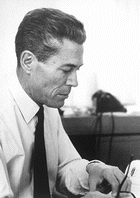
Fig.: Jacques Monod
|
|
Jacques Monod:
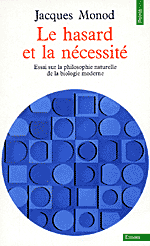
The original publication
called "Le hasard et la nécessité. Essai sur la philosophie
naturelle de la biologie moderne"
|
The difference between artificial
and natural objects seems immediately and unambiguously apparent to all of us.
A rock, a mountain, a river, or a cloud -these are natural objects; a knife,
a handkerchief, a car-so many artificial objects, artifacts. Analyze these judgments,
however, and it will I be seen that they are neither immediate nor strictly
objective. We know that the knife was man-made for a use its maker visualized
beforehand. The object renders in material form the preexistent intention that
gave birth to it, and its form is accounted for by the performance expected
of it even before it takes shape. It is another story altogether with the river
or the rock which we know, or believe, to have been molded by the free play
of physical forces to which we cannot attribute any design, any "project"
or purpose. Not, that is, if we accept the basic premise of the scientific method,
to wit, that nature is objective and not projective.
Hence it is through reference to our own activity, conscious and projective,
intentional and purposive-it is as makers of artifacts-that we judge of a given
object's "naturalness" or "artificialness." Might there
be objective and general standards for defining the characteristics of artificial
objects, products of a conscious purposive activity, as against natural objects,
resulting from the gratuitous play of physical forces? To make sure of the complete
objectivity of the criteria chosen, it would doubtless be best to ask oneself
whether, in putting them to use, a program could be drawn up enabling a computer
to distinguish an artifact from a natural object.
Such a program could be applied in the most interesting connections. Let us
suppose that a spacecraft is soon to be landed upon Venus or Mars; what more
fascinating question than to find out whether our neighboring planets are, or
at some earlier period have been, inhabited by intelligent beings capable of
projective activity? In order to detect such present or past activity we would
have to search for and be able to recognize its products, however radically
unlike the fruit of human industry they might be. Wholly ignorant of the nature
of such beings and of the projects they might have conceived, our program would
have to utilize only very general criteria, solely based upon the examined objects'
structure and form and without any reference to their eventual function.
The suitable criteria, we see, would be two in number: (a) regularity, and (b)
repetition. By means of the first one would seek to make use of the fact that
natural objects, wrought by the play of physical forces, almost never present
geometrically simple and straightforward structures: flat surfaces, for instance,
or rectilinear edges, right angles, exact symmetries; whereas artifacts will
ordinarily show such features, if only in an approximate or rudimentary manner.
Of the two criteria, repetition would probably be the more decisive. Materializing
a reiterated intent, homologous artifacts meant for the same use reflect, faithfully
in the main, the constant purpose of their creator. In that respect the discovery
of numerous specimens of closely similar objects would be of high significance.
These, briefly defined, are the general criteria that might serve. The objects
selected for examination, it must be added, would be of macroscopic dimensions,
but not microscopic. By macroscopic is meant dimensions measurable, say, in
centimeters; by microscopic, dimensions normally expressed in angstroms (a hundred
million of which equal one centimeter). This proviso is crucial, for on the
microscopic scale one would be dealing with atomic and molecular structures
whose simple and repetitive geometries, obviously, would attest not to a conscious
and rational intention but to the laws of chemistry.
Now let us suppose the program drawn up and the machine built. To check its
performance, the best possible test would be to put it to work upon terrestrial
objects. Let us invert our hypotheses and imagine that the machine has been
put together by the experts of a Martian NASA aiming at detecting evidence of
organized, artifact-producing activity on Earth. And let us suppose that the
first Martian craft comes down in the Forest of Fontainebleau, not far, let's
say, from the village of Barbizon. The machine looks at and compares the two
series of objects most prominent in the area: on the one hand the houses in
Barbizon, on the other hand the rock formations of Apremont. Utilizing the criteria
of regularity, of geometric simplicity, and of repetition, it will have no trouble
deciding that the rocks are natural objects and the houses artifacts.
Focusing now upon lesser objects, the machine examines some pebbles, near which
it discovers some crystals-quartz crystals, let us say. According to the same
criteria it should of course decide that while the pebbles are natural, the
quartz crystals are artificial objects. A decision which appears to point to
some "error" in the writing of the program. An "error" which,
moreover, proceeds from an interesting source: if the crystals present perfectly
defined geometrical shapes, that is because their macroscopic structure directly
reflects the simple and repetitive microscopic structure of the atoms or molecules
constituting them. A crystal, in other words, is the macroscopic expression
of a microscopic structure. An "error" which, by the by, should be
easy enough to eliminate, since all possible crystalline structures are known
to us.
But let us suppose that the machine is now studying another kind of object:
a hive built by wild bees, for example. There it would obviously find all the
signs indicating artificial origin: the simple and repeated geometrical structures
of the honeycombs and the cells composing them, thanks to which the hive would
earn classification in the same category of objects as the Barbizon dwellings.
What are we to make of this conclusion? We know the hive is "artificial"
insofar as it represents the product of the activity of bees. But we have good
reasons for thinking that this activity is strictly automatic-immediate, but
not consciously projective. At the same time, as good naturalists we view bees
as "natural" beings. Is there not a flagrant contradiction in considering
"artificial" the product of a "natural" being's automatic
activity?
Carrying the investigation a little further, it would soon be seen that if there
is contradiction, it results not from faulty programming but from the ambiguity
of our judgments. For if the machine now inspects, not the hive, but the bees
themselves, it cannot take them for anything but artificial, highly elaborated
objects. The most superficial examination will reveal in the bee elements of
simple symmetry: bilateral and translational. Moreover and above all, examining
bee after bee the computer will note that the extreme complexity of their structure
(the number and position of abdominal hairs, for example, or the ribbing of
the wings) is reproduced with extraordinary fidelity from one individual bee
to the next. Powerful evidence, is it not, that these creatures are the products
of a deliberate, constructive, and highly sophisticated order of activity? Upon
the basis of such conclusive documentation, the machine would be bound to signal
to the officials of the Martian NASA its discovery, upon Earth, of an industry
compared with which their own would probably seem primitive.
In this little excursion into the not-so-very-farfetched, our aim was only to
illustrate the difficulty of defining the distinction-elusive, for all its obviousness
to our intuitions-between "natural" and "artificial" objects.
In fact, on the basis of structural criteria, macroscopic ones, it is probably
impossible to arrive at a definition of the artificial which, while including
all "veritable" artifacts, such as the products of human workmanship,
would exclude objects so clearly natural as crystalline structures, and indeed,
the living beings themselves which we would also like to classify among natural
systems.
Looking for the cause of the confusion-or in any case, seeming confusion-the
program is leading to, we may perhaps wonder whether it does not arise from
our having wished to limit it to considerations only of form, of structure,
of geometry, and so divesting our notion of an artificial object of its essential
content. This being that any such object is defined or explained primarily by
the function it is intended to fulfill, the performance its inventor expects
of it. However, we shall soon find that by programming the machine so that henceforth
it studies not only the structure but the eventual performance of the examined
objects, we end up with still more disappointing results.
For let us suppose that this new program does enable the machine to analyze
correctly the structure and the performance of two series of objects -horses
running in a field and automobiles moving on a highway, for example. The analysis
would tend to the conclusion that these objects are closely comparable, those
making up each series having a built-in capacity for swift movement, although
over different surfaces, which accounts for their differences of structure.
And if, to take another example, we were to ask the machine to compare the structure
and performance of the eye of a vertebrate with that of a camera, the program
would have to acknowledge their profound similarities: lenses, diaphragm, shutter,
light-sensitive pigments: surely, the same components could not have been introduced
into both objects except with a view to getting similar performances from them.
The last of these examples is a classic one of functional adaptation in living
beings, and I have cited it only to emphasize how arbitrary and pointless it
would be to deny that the natural organ, the eye, represents the materialization
of a "purpose"-that of picking up images- while this is indisputably
also the origin of the camera. It would be the more absurd to deny it since,
in the last analysis, the purpose which "explains" the camera can
only be the same as the one to which the eye owes its structure. Every artifact
is a product made by a living being which through it expresses, in a particularly
conspicuous manner, one of the fundamental characteristics common to all living
beings without exception: that of being objects endowed with a purpose or project,
which at the same time they exhibit in their structure and carry out through
their performances (such as, for instance, the making of artifacts).
Rather than reject this idea (as certain biologists have tried to do) it is
indispensable to recognize that it is essential to the very definition of living
beings. We shall maintain that the latter are distinct from all other structures
or systems present in the universe through this characteristic property, which
we shall call teleonomy.
But it must be borne in mind that, while necessary to the definition of living
beings, this condition is not sufficient, since it does not propose any objective
criteria for distinguishing between living beings themselves and the artifacts
issuing from their activity.
It is not enough to point out that the project which gives rise to an artifact
belongs to the animal that created it, and not to the artificial object itself.
This obvious notion is also too subjective, as the difficulty of utilizing it
in the computer program would prove: for upon what basis would the machine be
able to decide that the project of picking up images-the project represented
by the camera-belongs to some object other than the camera itself? By examining
nothing beyond the finished structure and by simply analyzing its performance
it is possible to identify the project, but not its author or source.
To achieve this we must have a program which studies not only the actual object
but its origin, its history, and, for a start, how it has been put together.
Nothing, in principle at least, stands in the way of formulating such a program.
Even if it were rather crudely compiled, we would be able with it to discern
a radical difference between any artifact, however highly perfected, and a living
being. The machine could not fail to note that the macroscopic structure of
an artifact (whether a honeycomb, a dam built by beavers, a paleolithic hatchet,
or a spacecraft) results from the application to the materials constituting
it of forces exterior to the object itself Once complete, this macroscopic structure
attests, not to inner forces of cohesion between atoms or molecules constituting
its material (and conferring upon it only its general properties of density,
hardness, ductility, etc.), but to the external forces that have shaped it.
On the other hand, the program will have to register the fact that a living
being's structure results from a totally different process, in that it owes
almost nothing to the action of outside forces, but everything, from its overall
shape down to its tiniest detail, to "morphogenetic" interactions
within the object itself It is thus a structure giving proof of an autonomous
determinism: precise, rigorous, implying a virtually total "freedom"
with respect to outside agents or conditions-which are capable, to be sure,
of impeding this development, but not of governing or guiding it, not of prescribing
its organizational scheme to the living object. Through the autonomous and spontaneous
character of the morphogenetic processes that build the macroscopic structure
of living beings, the latter are absolutely distinct from artifacts, as they
are, furthermore, from the majority of natural objects whose macroscopic morphology
largely results from the influence of external agents. To this there is a single
exception: that, once again, of crystals, whose characteristic geometry reflects
microscopic interactions occurring within the object itself. Hence, utilizing
this criterion alone, crystals would have to be classified together with living
beings, while artifacts and natural objects, alike fashioned by outside agents,
would comprise another class.
That this last criterion, after those of regularity and repetition, should point
to a similarity between crystalline structures and the structures of living
beings might well set our programmer to thinking. Though unversed in modern
biology, he would be obliged to wonder whether the internal forces which confer
their macroscopic structure upon living beings might be of the same nature as
the microscopic interactions responsible for crystalline morphologies. That
this is indeed the case constitutes one of the main themes to be developed in
the ensuing chapters of this essay. But for the moment we are looking for the
most general criteria to define the macroscopic properties that set living beings
apart from all other objects in the universe.
Having "discovered" that an internal, autonomous determinism guarantees
the formation of the extremely complex structures of living beings, our programmer
(with no training in biology, but an information specialist by profession) must
necessarily see that such structures represent a considerable quantity of information
whose source has still to be identified: for all expressed-and hence received-information
presupposes a source.
Let us assume that, continuing his investigation, our programmer at last makes
his final discovery: that the source of the information expressed in the structure
of a living being is always another, structurally identical object. He has now
identified the source and detected a third remarkable property in these objects:
their ability to reproduce and to transmit ne varietur the information corresponding
to their own structure. A very rich body of information, since it describes
an organizational scheme which, along with being exceedingly complex, is preserved
intact from one generation to the next. The term we shall use to designate this
property is invariant reproduction, or simply invariance.
With their invariant reproduction we find living beings and crystalline structures
once again sharing a property that renders them unlike all other known objects
in the universe. Certain chemicals in supersaturated solution do not crystallize
unless the solution has been inoculated with crystal seeds. We know as well
that in cases of a chemical capable of crystallizing into two different systems,
the structure of the crystals appearing in the solution will be determined by
that of the seed employed. Crystalline structures, however, represent a quantity
of information by several orders of magnitude inferior to that transmitted from
one generation to another in the simplest living beings we are acquainted with.
By this criterion-purely quantitative, be it noted-living beings may be distinguished
from all other objects, crystals included.
Let us now forget our Martian programmer and leave him to mull things over undisturbed.
This imaginary experiment has had no other aim than to compel us to "rediscover"
the more general properties that characterize living beings and distinguish
them from the rest of the universe. Let us now admit to a familiarity with modern
biology, so as to go on to analyze more closely and to try to define more precisely,
if possible quantitatively, the properties in question. We have found three:
teleonomy, autonomous morphogenesis, and reproductive invariance.
Of them all, reproductive invariance is the least difficult to define quantitatively.
Since this is the capacity to reproduce highly ordered structure, and since
a structure's degree of order can be defined in units of information, we shall
say that the "invariance content" of a given species is equal to the
amount of information which, transmitted from one generation to the next, assures
the preservation of the specific structural standard. As we shall see later
on, with the help of a few assumptions it will be possible to arrive at an estimate
of this amount.
That in turn will enable us to bring into better focus the notion most immediately
and plainly inspired by the examination of the structures and performances of
living beings, that of teleonomy. Analysis nevertheless reveals it to be a profoundly
ambiguous concept, since it implies the subjective idea of "project."
We remember the example of the camera: if we agree hat this object's existence
and structure realize the "project" of capturing images, we must also
agree, obviously enough, that a similar project is accomplished with the emergence
of the eye of a vertebrate.
But it is only as a part of a more comprehensive project that each individual
project, whatever it may be, has any meaning. All the functional adaptations
in living beings, like all the artifacts they produce, fulfill particular projects
which may be seen as so many aspects or fragments of a unique primary project,
which is the preservation and multiplication of the species.
To be more precise, we shall arbitrarily choose to define the essential teleonomic
project as consisting in the transmission from generation to generation of the
invariance content characteristic of the species. All the structures, all the
performances, all the activities contributing to the success of the essential
project will hence be called "teleonomic."
This allows us to put forward at least the principle of a definition of a species'
"teleonomic level." All teleonomic, structures and performances can
be regarded as corresponding to a certain quantity of information which must
be transmitted for these structures to be realized and these performances accomplished.
Let us call this quantity "teleonomic information." A given species'
"teleonomic level" may then be said to correspond to the quantity
of information which, on the average and per individual must be transferred
to assure the generation-to-generation transmission of the specific content
of reproductive invariance.
It will be readily seen that, in this or that species situated higher or lower
on the animal scale, the achievement of the fundamental teleonomic project (i.e.,
invariant reproduction) calls assorted, more or less elaborate and complex structures
and performances into play. The fact must be stressed that concerned here are
not only the activities directly bound up with reproduction itself, but all
those that contribute-be it very indirectly-to the species' survival and multiplication.
For example, in higher mammals the play of the young is an important element
of psychic development and social integration. Therefore this activity has teleonomic
value, inasmuch as it furthers the cohesion of the group, a condition for its
survival and for the expansion of the species. it is the degree of complexity
of all these performances or structures, conceived as having the function of
serving the teleonomic purpose, that we would like to estimate.
This magnitude, while theoretically definable, is not measurable in practice.
Still, it may serve as a rule of thumb for ranking different species or groups
upon a "teleonomic scale." To take an extreme example, imagine a bashful
poet who, prevented by shyness from declaring his passion to the woman he loves,
can only express it symbolically, in the poems he dedicates to her. Suppose
that at last, conquered by these refined compliments, the lady surrenders to
the poet's desire. His verses will have contributed to the success of his essential
project, and information they contain must therefore be tallied in the sum of
the teleonomic performances assuring transmission of genetic invariance.
Indisputably, no analogous performance figures in the successful accomplishment
of the project in other animal species, the mouse for instance. But-and this
is the important point-the genetic invariance content is about the same in the
mouse and the human being (and in all mammals, for that matter). The two magnitudes
we have been trying to define are therefore quite distinct.
Which leads us to consider a most important question concerning the relationship
among the three properties we singled out as characteristic of living beings.
The fact that the computer program identified them successively and independently
does not prove that they are not simply three manifestations of a single, more
basic, more secret property, inaccessible to any direct observation. Were this
so, the drawing of distinctions among the properties, the seeking of different
definitions for them, might be nothing but delusion and arbitrariness. Far from
shedding light on the real problem, far from tracking down "the secret
of life" and truly dissecting it, we would be engaged merely in exorcizing
it.
It is perfectly true that these three properties-teleonomy, autonomous morphogenesis,
and reproductive invariance -are closely interconnected in all living beings.
Genetic invariance expresses and reveals itself only through, and thanks to,
the autonomous morphogenesis of the structure that constitutes the teleonomic
apparatus.
There is this to be observed right away: not all of these three concepts have
the same standing. Whereas invariance and teleonomy are indeed characteristic
"properties" of living beings, spontaneous structuration ought rather
to be considered a mechanism. Further on we shall see that this mechanism intervenes
both in the elaboration of teleonomic structures and in the reproduction of
invariant information as well. That it finally accounts for the latter two properties
does not, however, imply that they should be regarded as one. It remains possible-it
is in fact methodologically indispensable -to maintain a distinction between
them, and this for several reasons:
1. One can at least imagine objects capable of invariant reproduction but devoid
of any teleonomic apparatus. Crystalline structures offer one example of this,
at a level of complexity admittedly very much lower than that of all known living
organisms.
2. The distinction between teleonomy and invariance is more than a mere logical
abstraction. It is warranted on grounds of chemistry. Of the two basic classes
of biological macromolecules, one, that of proteins, is responsible for almost
all teleonomic structures and performances; while genetic invariance is linked
exclusively to the other class, that of nucleic acids.
3. Final , as will be seen in the next chapter, this distinction is assumed,
explicitly or otherwise, in all the theories, all the ideological constructions
(religious, scientific, or philosophical) pertaining to the biosphere and to
its to the rest of the universe.
Living creatures are strange objects. At all times in the past, men must have
been more or less confusedly aware of this. The development of the natural sciences
beginning in the seventeenth century, their flowering in the nineteenth, instead
of effacing this impression rather rendered it more acute. Over against the
physical laws governing macroscopic systems, the very existence of living organisms
seemed to constitute a paradox, violating certain of the fundamental principles
modern science rests upon. Just which ones? That is not immediately clear. Hence
the question is, precisely, to analyze the nature of this-or these-"paradoxes."
This will give us occasion to specify the relative position, vis-à-vis
physical laws, of the two essential properties that characterize living organisms:
reproductive invariance and structural teleonomy.
Indeed at first glance invariance appears to constitute a profoundly paradoxical
property, since the maintaining, the reproducing, the multiplying of highly
ordered structures seems in conflict with the second law of thermodynamics.
This law enjoins that no macroscopic system evolve otherwise than in a downward
direction, toward degradation of the order that characterizes it.
However, this prediction of the second law is valid, and verifiable, only if
we are considering the overall evolution of an energetically isolated system.
Within such a system, in one of its phases, we may see ordered structures take
shape and grow without that system's overall evolution ceasing to comply with
the second law. The best example of this is afforded by the crystallization
of a saturated solution. The thermodynamics of such a system are well understood.
The local enhancement of order represented by the assembling of initially unordered
molecules into a perfectly defined crystalline network is "paid for"
by a transfer of thermal energy from the crystalline phase to the solution:
the entropy-or disorder-of the system as a whole augments to the extent stipulated
by the second law.
This example shows that, within an isolated system, a local heightening of order
is compatible with the second law. We have pointed out, however, that the degree
of order represented by even the simplest organism is incomparably higher than
that which a crystal defines. We must now ask whether the conservation and invariant
multiplication of such structures is also compatible with the second law. This
can be verified through an experiment closely comparable with that of crystallization.
We take a milliliter of water having in it a few milligrams of a simple sugar,
such as glucose, as well as some mineral salts containing the essential elements
that enter into the chemical constituents of living organisms (nitrogen, phosphorus,
sulfur, etc.). In this medium we grow a bacterium, for example Escherichia coli
(length, 2 microns; weight, approximately 5 X 10¯¹³ grams). Inside
thirty-six hours the solution will contain several billion bacteria. We shall
find that about 40 per cent of the sugar has been converted into cellular constituents,
while the remainder has been oxidized into carbon dioxide and water. By carrying
out the entire experiment in a calorimeter, one can draw up the thermodynamic
balance sheet for the operation and determine that, as in the case of crystallization,
the entropy of the system as a whole (bacteria plus medium) has increased a
little more than the minimum prescribed by the second law. Thus, while the extremely
complex system represented by the bacterial cell has not been conserved but
has multiplied several billion times, the thermodynamic debt corresponding to
the operation has been duly settled.
No definable or measurable violation of the second law has occurred. Nonetheless,
something unfailingly upsets our physical intuition as we watch this phenomenon,
whose strangeness is even more appreciable than before the experiment. Why?
Because we see very clearly that this process is bent or oriented in one exclusive
direction: the multiplication of cells. These to be sure do not violate the
laws of thermodynamics, quite the contrary. They not only obey them; they utilize
them as a good engineer would, with maximum efficiency, to carry out the project
and bring about the "dream" (as François Jacob has put it)
of every cell: to become two cells.
Later we shall try to give an idea of the complexity, the subtlety, and the
efficiency of the chemical machinery necessary to the accomplishment of a project
demanding the synthesis of several hundred different organic constituents; their
assembly into several thousand macromolecular species; and the mobilization
and utilization, where necessary, of the chemical potential liberated by the
oxidation of sugar: i.e., in the construction of cellular organelles. There
is, however, no physical paradox in the invariant reproduction of these structures:
invariance is bought at not one penny above its thermodynamic price, thanks
to the perfection of the teleonomic apparatus which, grudging of calories, in
its infinitely complex task attains a level of efficiency rarely approached
by man-made machines. This apparatus is entirely logical, wonderfully rational,
and perfectly adapted to its purpose: to preserve and reproduce the structural
norm. And it achieves this, not by departing from physical laws, but by exploiting
them to the exclusive advantage of its personal idiosyncrasy. It is the very
existence of this purpose, at once both pursued and fulfilled by the teleonomic
apparatus, that constitutes the "miracle." Miracle? No, the real difficulty
is not in the physics of the phenomenon; it lies elsewhere, and deeper, involving
our own understanding, our intuition of it. There is really, no paradox or miracle;
but a flagrant epistemological contradiction.
The cornerstone of the scientific method is the postulate that nature is objective.
In other words, the systematic denial that "true" knowledge can be
got at by interpreting phenomena in terms of final causes-that is to say, of
"purpose." An exact date may be given for the discovery of this canon.
The formulation by Galileo and Descartes of the principle of inertia laid the
groundwork not only for mechanics but for the epistemology of modern science,
by abolishing Aristotelian physics and cosmology. To be sure, neither reason,
nor logic, nor observation, nor even the idea of their systematic confrontation
had been ignored by Descartes' predecessors. But science as we understand it
today could not have been developed upon those foundations alone. It required
the unbending stricture implicit in the postulate of objectivity- ironclad,
pure, forever undemonstrable. For it is obviously impossible to imagine an experiment
which could prove the nonexistence anywhere in nature of a purpose, of a pursued
end.
But the postulate of objectivity consubstantial with science; it has guided
the whole of its prodigious development for three centuries. There is no way
to be rid of it, even tentatively or in a limited area, without departing from
the domain of science itself.
Objectivity nevertheless obliges us to recognize the teleonomic character of
living organisms, to admit that in their structure and performance they act
projectively- realize and pursue a purpose. Here therefore, at least in appearance,
lies a profound epistemological contradiction. In fact the central problem of
biology lies with this very contradiction, which, if it is only apparent, must
be resolved; or else proven to be utterly insoluble, if that should turn out
indeed to be the case.