MSc Creative Games, International Network
An international network of partner universities, colleagues and fellow researchers throughout the world provides the MSc Creative Games in a loop with current and future developments. MSc Creative staff have actively being teaching in Stockholm, Helsinki, Vienna, Leipzig, Potsdam, Zurich and other locations. This guarantees for a lively exchnage of knowledge, guest lecturers visiting the MSc and student exchange.
We are currently developing a Joint European Masters programme in Ludic Interfaces, planned to be kicking off in 2012.
The programme will be run amingst Salford University, Manchester/ UK, UfG Linz/ AT, Universidad Politécnica de Valencia/ ES, University of Potsdam/ D, University of Huddinge/ SE (corresponding partner)
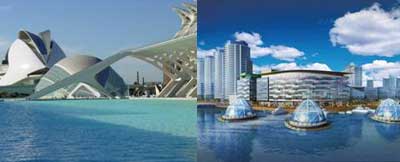
From left to right: Valencia (City of Arts & Sciences), Salford (MediaCity)
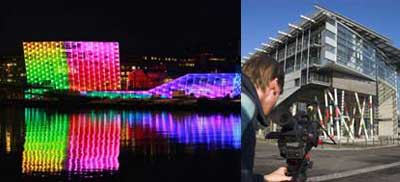
From left to right: Linz (ars electronica), Potsdam-Babelsberg (Media City)
Programme Content: Creative Games, Interfaces, Cultural Studies of Future and Current Media, Ludic Societies, Ludic Interfaces
Aims: To establish a Masters Programme which creatively investigates --- Future Forms and Applications of Ludic Interfaces --- as a technocultural perspective for a European networked society.
Rationale: The European knowledge economy will be fuelled by a multitude of new and unforeseen creative solutions to social and technical problems. These tools and concepts differ from traditional technological systems as they are often - playfull - user-generated and user-driven - flexible - low-cost - cooperative. Ludic interfaces take the best from computer games, artistic experiment, interactive media, media conversion, social networks and modding cultures to offer tools which are adaptive to cultural specifica and cultural change, are sensitive to gender-related, age-related and ethnic specificities. These tools offer an ease of use and playfulness to cope with a rapidly changing society. The methodologies for the development of future media and the analysis of new and emerging media draws from the canon of artistic practice, HCIUE (human computer interfaces and usability engineering), collaborative content creation (wikis, blogs, social networking, prototyping, bending- and modding practices).
Why Linz, Valencia, Manchester and Potsdam? Linz and Manchester are important European “Second Cities” with a strong historic and economic backbone in industrialisation, the decline of labour industries and the transformation into Media Cities. MediaCity Salford and ars electronica form cornerstones for a prosperous knowledge economy of the 21st century. The universities established courses in digital media and are committed to develop new forms of collaboration and development. Similar to Linz’s “ars electronica Centre” and Salford’s forthcoming MediaCity, Valencia hosts the “City of Arts and Sciences” which attracts 4 million annual visitors and is equally fascinating to adults and children alike. Potsdam hosts a historical site of film and media production. Media City Potsdam-Babelsberg can look back at a glamorous past with “Der Blaue Engel” and “Metropolis” being produced at the premises, it is however looking forward to turn into one of the most relevant spots for European film and contains a core research centre for philosophical, historical and sociological aspects of computer games. The research centre “Zentrum für Computerspielforschung (DIGAREC) der Universität Potsdam” investigates interfaces, age and gender related issues of computer games, and game art. The vicinity of the universities to world class art & science showcases and event sites will create a network of excellence amongst academic research, higher education, art and entertainment.